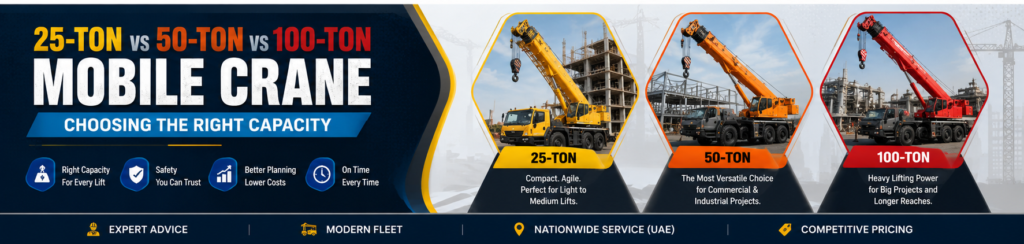
25-Ton vs 50-Ton vs 100-Ton Mobile Crane: Choosing the Right Capacity
Choosing the wrong crane capacity is one of the most expensive mistakes a contractor can make on a UAE job site. Order a crane that’s too small and the lift gets rejected on-site, the schedule slips, and you pay mobilization twice. Order one that’s too big and you’re paying thousands of extra dirhams a day for capacity you never use.
The tonnage rating on a mobile crane — 25-ton, 50-ton, 100-ton — is only the headline number. The crane that actually gets your load up safely depends on lift weight, radius, boom angle, and ground conditions working together. Here’s how to read that correctly and pick the right size for your project.
Why “Tonnage” Alone Doesn’t Tell You What a Crane Can Lift
Every mobile crane’s rated capacity is based on lifting the load at minimum radius, with the boom fully retracted and positioned directly over the front of the machine. That’s the best-case number manufacturers publish, and it’s rarely the number you’ll actually get on-site.
The real lifting capacity depends on:
- Radius — the horizontal distance from the crane’s center of rotation to the load. Capacity drops sharply as radius increases.
- Boom length and angle — a fully extended boom lifts far less than a retracted one.
- Outrigger spread — full outrigger extension gives maximum stability and capacity; a confined site that limits outrigger spread cuts capacity significantly.
- Lift height — reaching over an existing structure or into a shaft changes the working radius and boom angle needed.
- Ground bearing pressure — soft or uneven ground reduces safe capacity regardless of the crane’s rated tonnage.
This is why two contractors renting the “same” 50-ton crane for two different jobs can end up with completely different usable capacities. Any competent crane rental company should ask for your load weight, lift radius, and lift height before confirming a crane size — not just take a tonnage request at face value.

25-Ton Mobile Crane: Best For
A 25-ton mobile crane is the workhorse of light-to-medium lifting in the UAE — compact, quick to mobilize, and cost-efficient for jobs that don’t need serious reach or capacity.
Typical uses:
- Loading and unloading building materials, precast panels, and steel sections
- Villa and low-rise residential construction
- HVAC unit and rooftop equipment placement
- Placing small precast blocks, AC chillers, or generators
- Quick-turnaround jobs in tight urban plots (Dubai villa communities, Sharjah residential zones)
Why contractors choose it: low daily rental cost, fast setup (often under an hour), easy access into tight or residential sites, and no need for police escorts or wide-load permits during transport.
Where it falls short: limited radius at higher capacities, and it simply can’t handle structural steel erection, tower crane component lifts, or anything beyond low-rise work.
50-Ton Mobile Crane: Best For
The 50-ton class is the most commonly rented mobile crane on UAE mid-size commercial and industrial sites — it’s the practical middle ground between agility and lifting power.
Typical uses:
- Mid-rise building construction (4-15 stories)
- Structural steel erection for warehouses and industrial sheds
- Precast concrete panel installation
- Tower crane assembly and dismantling support
- Placing rooftop plant equipment, cooling towers, and transformers
- General commercial and infrastructure projects across Dubai, Abu Dhabi, and Sharjah
Why contractors choose it: enough capacity and boom length to handle most commercial lifts, while still being mobile enough to move between multiple pick points on a single site in one day. It’s the size most rental fleets in the UAE stock the most of, which also means better availability and more competitive daily rates.
Where it falls short: heavy structural steel, large precast girders, and high-rise tower crane erection typically exceed what a 50-ton crane can safely handle at useful radius.
100-Ton Mobile Crane: Best For
A 100-ton mobile crane is a heavy-lift asset, usually mobilized for specific, high-value lifts rather than general site work.
Typical uses:
- Tower crane erection and dismantling (lifting mast sections, counter-jibs, and slewing units)
- Heavy structural steel and large-span truss installation
- Precast bridge girders and heavy infrastructure components
- Industrial plant, refinery, and oil & gas equipment installation
- Long-radius lifts where the load must clear existing structures
Why contractors choose it: it can lift heavier loads at longer radii than a 50-ton crane, which is critical for tower crane jobs and large industrial lifts where there’s no room to bring the load in close.
Where it falls short: higher daily rate, longer mobilization time (multi-axle transport, sometimes with a traffic police escort for oversized loads), and it needs more ground preparation and outrigger space — not ideal for confined or residential sites.
Side-by-Side Comparison
| Factor | 25-Ton | 50-Ton | 100-Ton |
|---|---|---|---|
| Best for | Light lifting, villas, materials handling | Mid-rise, structural steel, tower crane support | Heavy lift, tower crane erection, industrial |
| Typical boom length | ~30–35m | ~40–50m | ~50–60m+ |
| Mobilization time | Fast (under 1 hour) | Moderate (1–2 hours) | Longer (multi-load transport, may need escort) |
| Site space needed | Minimal | Moderate outrigger spread | Full outrigger spread, firm ground required |
| Relative daily cost | Lowest | Mid-range | Highest |
| Common project type | Residential, small commercial | Commercial, industrial, mid-rise | High-rise, infrastructure, heavy industrial |
How to Decide Which One You Actually Need
Rather than starting with a tonnage number, work backward from the lift itself:
- Know your heaviest single load — not the average, the heaviest piece you’ll ever lift on that job.
- Know your maximum radius — the farthest horizontal distance the crane will need to reach that load from a position it can actually stand.
- Know your lift height — especially if you’re lifting over an existing structure or into an upper floor.
- Check your ground conditions and access — a 100-ton crane needs firm, level ground and space for full outrigger spread; if your site can’t provide that, a smaller crane with a closer approach may outperform a bigger one that can’t set up properly.
- Share all of this with your rental provider before booking, not on the day of the lift. A proper crane rental company will run the load chart against your actual figures and confirm the right machine — or flag if you need a bigger one, or occasionally a smaller one that’s cheaper for the job.
When in doubt, oversizing slightly is safer than undersizing — but the right answer is almost always found by matching load, radius, and site conditions to a load chart, not by guessing at tonnage.
Get the Right Crane, Not Just a Crane
At UAE Crane Rentals, we don’t just rent out tonnage — we match the crane to your actual load chart requirements across Dubai, Abu Dhabi, Sharjah, and the rest of the UAE. Our team will review your lift weight, radius, and site conditions before recommending a 25-ton, 50-ton, 100-ton, or larger mobile crane, so you’re not overpaying or under-equipped on lift day.
Get a Free Quote or call +971 522652617 to speak with our team about the right crane for your project.
Frequently Asked Questions
Can a 25-ton crane be upgraded to a 50-ton crane on the same job if needed? Yes, most UAE rental companies can swap or add a larger crane, but it means a second mobilization charge and possible delay. It’s more cost-effective to confirm the correct capacity upfront based on your heaviest lift and radius.
Is a 50-ton mobile crane enough for a tower crane erection? It depends on the tower crane model and mast section weight. Many self-erecting and smaller tower cranes can be assembled with a 50-ton mobile crane, but larger hammerhead tower cranes typically require 100-ton or heavier capacity for the counter-jib and mast sections.
Does a bigger crane always cost more per day? Generally yes — daily rental rates scale with tonnage due to transport, mobilization, and operator requirements. However, if a smaller crane can’t safely make the lift at your required radius, the cost of a failed or unsafe lift is far higher than the price difference in rental rate.
Do I need a permit to move a 100-ton mobile crane on UAE roads? Oversized or heavy transport loads often require special road permits and, in some cases, a police escort depending on the route and axle configuration. Your rental provider should handle these arrangements as part of mobilization.
What information should I give a crane rental company to get an accurate size recommendation? Provide the exact load weight, the lift radius (distance from where the crane can stand to the load’s final position), the lift height, and details about ground conditions and site access. This lets the provider check the actual load chart rather than guessing based on tonnage alone.
Frequently Asked Questions (FAQs)
Is a 50-ton mobile crane enough for a tower crane erection?
It depends on the tower crane model and mast section weight. Many self-erecting and smaller tower cranes can be assembled with a 50-ton mobile crane, but larger hammerhead tower cranes typically require 100-ton or heavier capacity for the counter-jib and mast sections.
Does a bigger crane always cost more per day?
Generally yes — daily rental rates scale with tonnage due to transport, mobilization, and operator requirements. However, if a smaller crane can't safely make the lift at your required radius, the cost of a failed or unsafe lift is far higher than the price difference in rental rate.
Do I need a permit to move a 100-ton mobile crane on UAE roads?
Oversized or heavy transport loads often require special road permits and, in some cases, a police escort depending on the route and axle configuration. Your rental provider should handle these arrangements as part of mobilization.
What information should I give a crane rental company to get an accurate size recommendation?
Provide the exact load weight, the lift radius (distance from where the crane can stand to the load's final position), the lift height, and details about ground conditions and site access. This lets the provider check the actual load chart rather than guessing based on tonnage alone.